The short answer: No.
But since this project does involve crypto (see "How Do I Invest in QuStream"), it's more than fair to wonder.
First we'll share corroborating evidence from around the web, and then we'll address specific concerns.
Corroborating Evidence
Leadership & track record
The CEO is Adrian Neal, per the QuStream web site.
His LinkedIn profile highlights a wide range of experience in cybersecurity across various industries, and also states:
- He is an Oxford University graduate. (This 2015 Annual Report hosted on the University of Oxford web site mentions his alumni status.)
- He is currently Senior Director | Global Lead - Post-Quantum Cryptography (which is close enough to his title displayed at the bottom of this page on the Capgemini site).
- He is also currently the Co-Founder and Chief Executive Officer of QuStream
- He founded Oxford BioChronometrics, winning the NATO NCIA Defence Innovation Challenge for Advances in Cybersecurity in 2017. NATO acknowledges that win here.
- He founded Oxford Scientifica (support: He has an oxfordscientifica.com email address that can be found all over the web), winning the 2019 NATO NCIA Defence Innovation Challenge for Signal Resilience in the High North. NATO acknowledges that win here.
Research & public participation
Adrian presented the QuStream solution (the q-stream algorithm) as an invited guest at the TechNet Europe 2025 conference "Transforming Defence in a Digital World" alongside speakers from NATO and other military, intelligence, cybersecurity, etc. organizations (see speakers list).
Adrian presented his double-blind peer-reviewed paper on the QuStream quantum-proof encryption solution at the 2025 Future Technologies Conference. This paper was subsequently published by the Springer Nature journal.
Security review & infrastructure partnerships
On the crypto side of things, QuStream has had a staking contract audited by Halborn, a highly reputable company providing security reviews and penetration testing for leading blockchain projects. We don't know how much they paid, but a Halborn audit can easily run $50,000 -- not something scammers would spend money on.
QuStream partnered with another highly reputable company, Ankr (specifically their Asphere division -- see announcement) to build out the initial Layer 2 (L2) network on the Polygon blockchain as a home for the encryption node network so it can run while the QuStream Layer 1 (L1) standalone blockchain is being implemented. Ankr is a well-known architect of blockchain infrastructure used across multiple major networks.
Potential Red Flags
They have a crypto token -- so it must be a scam!
Yes, there are a lot of scams out there in crypto-land. No, not everything that touches crypto is a scam. We recommend that you review the Corroborating Evidence at the top of this page thoroughly. A range of real-world authorities are taking this project seriously so we are too.
They used pump.fun to launch their crypto token!
"...and everything that launches through pump.fun is a scam."
We hear you -- a LOT of people have this reaction.
Yes, QuStream was launched via pump.fun. It's pretty unmissable: Their contract address ends in "pump".
Fact: QuStream needed a launchpad, and pump.fun is a "fair launch" service that gives everyone equal access to buy the token as soon as it launches. Yes, there have been problematic projects launched on pump.fun, but legitimate projects have also used their services.
That said, when QuStream moves to its own Level 1 blockchain in 2026 the token will get a new contract address, and this particular concern will stop being quite so aggressively visible.
QuStream isn't on NIST's list of approved Post-Quantum Computing (PQC) algorithms
The U.S. National Institute of Science and Technology (NIST) has approved a number of "quantum resistant" algorithms. (See What is QuStream? for more information on how these compare to QuStream's offering.)
While it was lost during a web site overhaul, their past stance (still viewable on the internet archive) has been opposition to commercial solutions, which is likely still a guiding factor even if not spelled out quite so clearly on their current site. This is what they had said previously:
"NIST has observed that royalty-free availability of cryptosystems and implementations has facilitated adoption of cryptographic standards in the past. For that reason, NIST believes it is critical that this process leads to cryptographic standards that can be freely implemented in security technologies and products. As part of its evaluation of a PQC cryptosystem for standardization, NIST will consider assurances made in the statements by the submitter(s) and any patent owner(s), with a strong preference for submissions as to which there are commitments to license, without compensation, under reasonable terms and conditions that are demonstrably free of unfair discrimination."
However, it's not clear how QuStream being a commercial venture is any different than an SSL certificate vendor or a VPN service doing business. Security is a market, and professionals handling security isn't inherently a bad thing.
They said they're a Level 1 Blockchain -- but they're not!
Reports of QuStream's L1 blockchain status are, shall we say, forward-looking? "Advance SEO"? As of this writing QuStream's L1 blockchain is still months away -- but Ankr is busily working away on it, so it's as real as something that's still being constructed can be.
Why are there are two different QuStream web sites?
This one's easy: The commercial venture is hosted at QuStream.com, and the more academic side of things (focusing on the "q-stream" algorithm) is hosted at QuStream.co.uk.
I found a scammy QuStream group on Telegram!
Yes -- Telegram is a dangerous place for unwary investors. QuStream did have a Telegram group for a while but they moved to Discord. We've seen that there are at least two fake "Official QuStream" groups on Telegram, and in our experience if you go in there and try to tell people they're being misled then you will get booted quick. If you want to be sure you're in the right place, go to the Contact page on QuStream's web site and click through the social links below the contact form. (There isn't a link to Telegram there.)
I saw a fake QST token for sale!
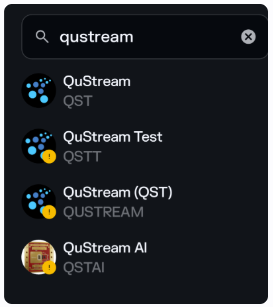
Scammers target real tokens all the time. They also target meme coins, junk coins -- any coin they can, really. For example, at this moment if you search for "qustream" on Solflare wallet you'll see several fakes. This is why (as outlined on the How to invest page) it's critical that you search by contract address when there's any doubt which one you should click on.
The real QuStream (QST) token, followed by several fakes: